
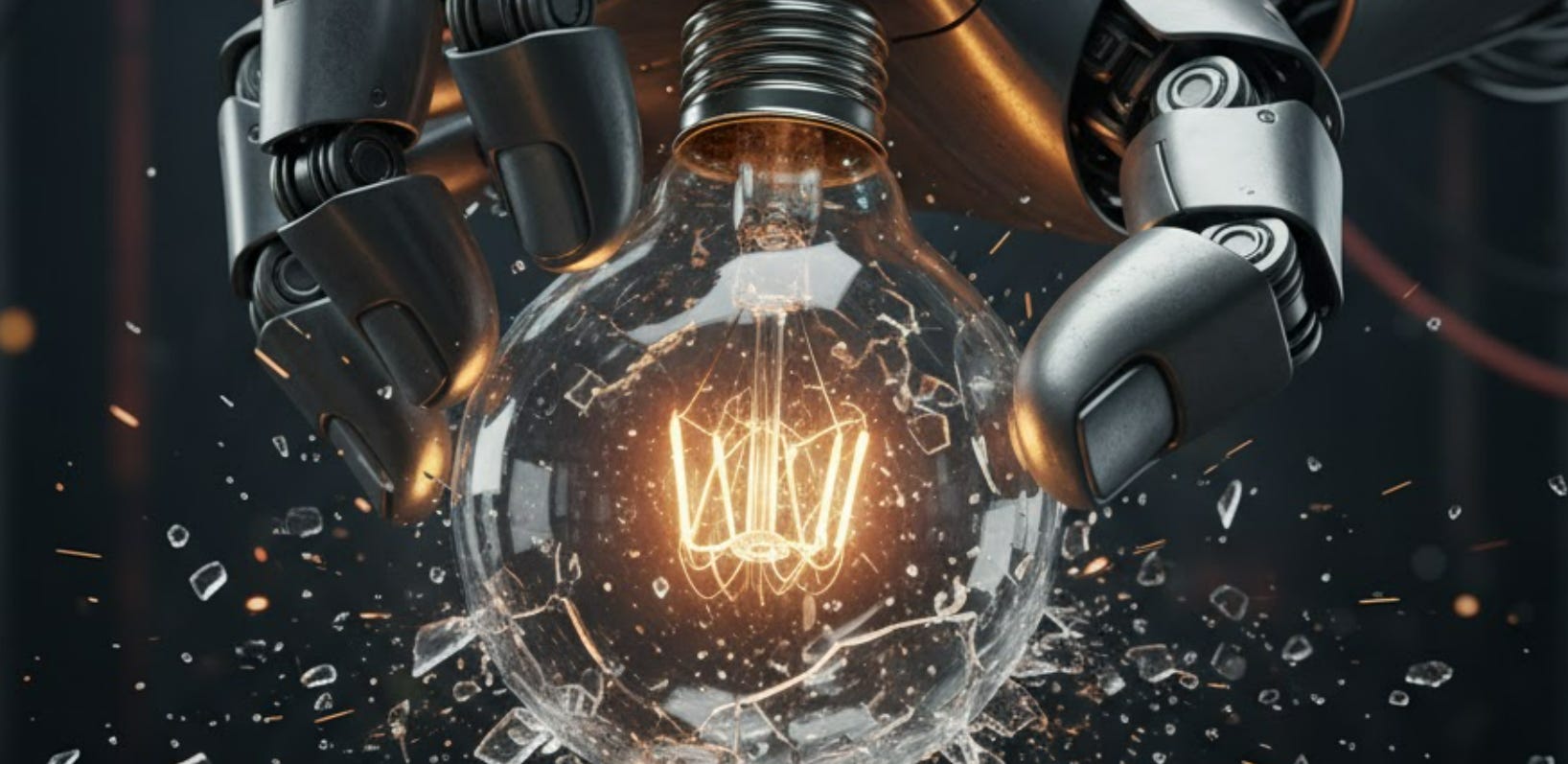
Does AI-generated content enhance our creativity or crush it?
PLUS: The case against Netflix's "binge drop" strategy
Welcome! I’m Simon Owens and this is my media industry newsletter. If you’ve received it, then you either subscribed or someone forwarded it to you.
If you fit into the latter camp and want to subscribe, then you can click on this handy little button:
Let’s jump into it…
A quick note on programming
I’ve been trying to optimize my work schedule so I can spend as much time as possible working on original reporting, both for the podcast and newsletter.
This means spending my Tuesdays and Thursdays compiling the news roundups like the one you’re reading now and then devoting my remaining workweek to research, source interviews, writing, and editing. But the problem with reporting is it takes time, and I often feel guilty if I’m not delivering at least one piece of original content a week.
If I were just doing the podcast, then this weekly cadence would be possible, but I also really enjoy writing long pieces that require multiple source interviews and thousands of words. If I want to write more of these pieces, then I have to be ok with having weeks go by where all I send out are the news roundup newsletters.
All this is to say that, from here forward, I’m going to try to stick to my guns and actually report stuff out. This means that some weeks you’ll receive just the two roundup newsletters and other weeks you’ll also get something more in-depth and completely original. My goal is to produce at least two podcast episodes and one longform article per month.
As always, I’m open to feedback. Feel free to comment here:
The Atlantic: A Tool That Crushes Creativity
From the article:
At its core, [AI] slop invites a kind of nihilism into all aspects of our life. AI boosters claim that its tools will inject an unfathomable abundance of humanlike brainpower into the world, unlocking our collective potential as a species. But so far its chief output seems to stand in direct opposition to this idea: Its infrastructure of meaninglessness makes the very act of creating something of meaning almost irrelevant.
Sometimes I wonder how much the spread of AI-generated junk content is driven by its lingering novelty. This is, after all, a completely new technology that our 20th-century brains are still adjusting to, and it can still feel a bit futuristic when we encounter it. But in my own browsing, I’ve noticed that once I come across a new genre of AI slop—say, on Instagram—the novelty quickly fades. Before long, I’m just scrolling past it without a second thought. Even though AI-produced content has supposedly outpaced human-made material in sheer volume, most of what I actually consume is still created by humans—a sign that much of the AI stuff is already being filtered out of our lives.
Creator Spotlight: Building a $500K local news business
From the article:
Geoff Sharpe isn’t a journalist, but he’d figured out how to build a paying audience for local journalism.
He’s the founder of Lookout Media, a growing network of newsletters with four active publications across three cities: Ottawa Lookout, Van City Lookout, Yukon Lookout, and Capital Eats …
Geoff reinvests every dollar made through Lookout Media into hiring journalists and sustains himself through his marketing agency. Growth remains conservative, with nine to twelve months of runway before any hiring, and no venture funding. In the next four years, he aims to launch neighborhood-specific newsletters in five to six more cities, establishing Lookout Media as the most trusted news brand in every market they enter.
The cool thing about running a local news startup is that if you can find a model that works in one local area, you can usually copy and paste that same model into other regions.
ICYMI: How The Author Stack grew to over 31,000 subscribers
The Rebooting: The Monocle playbook
You kind of have to admire Monocle for never chasing scale, even though the magazine was around during that era a decade ago when VCs would have gladly tossed it a lot of cash to build out its web presence. It recognized early on that there’s a certain coolness factor for publications willing to stay small and relatively print-centric, and it monetizes that coolness by selling ads to luxury brands.
From the article:
“I think of our subscribers as part of a club, even if we don’t call it that,” Monocle founder Tyler Brûlé told me at Monocle’s Paris cafe, where we recorded a conversation over a civilized glass of wine. “There’s a real sense of fraternity among our readers.”
The key to making this work, he told me, is achieving “proximity” with the audience by actually talking to them rather than looking at dashboards. For Monocle’s luxury advertisers, that kind of proximity is far more attractive than dull performance marketing on Instagram where their brands are in a feed with all kinds of riffraff.
The Wrap: Zohran Mamdani’s Flood-the-Zone Media Strategy Looks Like a Winning One
Zohran Mamdani has designed a template for how politicians can break through in a crowded news market; he created his own highly engaging — and often funny — content that was primed to go viral. That virality then led to interest from traditional media.
Meanwhile, most Democratic candidates are still hiring the same small group of shitty digital consultants whose online strategy consists of buying email addresses and phone numbers and then relentlessly spamming voters with unsolicited donation requests.
From the article:
Mamdani’s earlier video efforts demonstrate how candidates can harness YouTube and TikTok to address pocketbook concerns in clever and engaging ways. In one video, “Halalflation,” Mamdani talks to vendors about the cost of food and parking permits before highlighting how specific bills before the city council could save money — all in about 90 seconds.
What’s striking is how Mamdani has stayed consistent in his economic message this past year while vastly expanding his media reach, becoming not only the main character in a local mayoral race, but an emerging player on the national stage.
Want to reach the top leaders in media, marketing, and the Creator Economy?
My newsletters has 18,000 subscribers and generates upwards of 200,000 impressions per month. Its audience spans across news media, Hollywood, marketing departments, PR agencies, and the Creator Economy. If you want to reach this audience with your product or service, check out my sponsorship page.
Hollywood Reporter: The (Academic) Case Against the Netflix Episode-Release Strategy
Ever since Netflix pioneered the strategy of releasing an entire TV season at once, there’s been an ongoing debate in Hollywood as to whether it’s better to binge drop seasons or drip them out slowly. New academic research found that the latter “leads to a 48 percent greater short-term retention,” though I would still argue the former is more preferable for the actual consumer.
From the article:
For the study, CMU partnered with an unnamed “large multinational telecommunications provider” just ahead of its rollout of four series: Big Little Lies, The Muppets, The Young Pope, and Unforgettable. The TELCO had the rights to manipulate the release strategy of these shows as it saw fit, providing researchers the variable control needed. The randomized field trial assigned viewers, average age 49, either a drip release schedule or an all-at-once release schedule. The study consisted of two stages of five weeks apiece.
CMU found that both strategies have their “own merits.”
Weekly releases can “deter consumers from engaging with the focal show,” and push them to “explore [the streamer’s] catalog more actively,” the report states. These users tend to “visit the platform more frequently during the whole release period.”
AdWeek: The New York Times Launches TikTok-Inspired ‘Watch’ Tab
The New York Times has made a huge investment in its video operations over the past year, launching everything from video podcasts to highly-produced mini documentaries to shortform vertical videos — all together totaling to 75 hours of content per month. It’s also trying to nudge a larger share of its audience into consuming this video content in its app, going so far as to launch a TikTok-like video tab.
From the article:
The swipeable video feed, which has been available to a small cohort of users for several weeks, will feature short-form clips spanning The Times’ portfolio—News, Opinion, Cooking, Wirecutter, and The Athletic—curated and refreshed throughout the day …
Unlike TikTok or Instagram Reels, Watch will launch without advertising or algorithmic personalization …
For now, the goal is to learn how users interact with short-form video—what they watch, finish, and return to—before introducing marketing opportunities.
The Guardian: Once a stalwart of Hong Kong’s journalism scene, Wang Jian has found a new audience on YouTube
A Chinese journalist fled from Hong Kong to the US in 2018, and now he broadcasts twice a day to his 800,000 Mandarin-speaking YouTube subscribers. He covers US politics through the lens of someone who grew up in a dictatorship, often drawing parallels between Trump’s authoritarian actions and the policies he experienced in his home country.
From the article:
He is part of an exodus of media professionals who have left Hong Kong and mainland China in the past decade; and one of a handful who have started posting news and analysis videos on YouTube. Wang serves an audience of Chinese expatriates – along with mainlanders savvy enough to get round China’s great firewall – who tune in hoping that he can fill in the gaps left by propaganda, censorship and disinformation.
Wang’s fans find him entertaining and reassuringly professional. (“He’s very objective, I think,” one told me.) His broadcast manner moves from the impersonal, rhythmic cadence of a veteran newscaster to personal asides that bring to mind a slightly incredulous university lecturer. He loves a rhetorical question (“Is this the way a US president speaks?”) followed by his favourite English-language interjection: “C’mon.”
If you get any value out of my newsletter or podcast…
…please consider becoming a paid subscriber. Subscribing gets you access to a huge and growing index of media case studies. Use the link below and get 20% off for your first year:
Yahoo: On Substack, TV News Personalities Find a 2nd — and Successful — Life
Former TV news personalities have been some of the biggest winners in the Creator Economy, as the parasocial relationships they developed with audiences on networks like CNN and MSNBC led to viewers following them onto platforms like YouTube and Substack. From a content standpoint, there’s not a big difference between a cable news broadcast and a video podcast.
From the article:
In nearly two years, [Mehdi] Hasan said, he’s seen revenue in the “several millions” with more than 564,000 subscribers on Substack and 1.4 million YouTube subscribers. Hasan said 1,000 subscribers are considered “founding members” who pay $500 annually, amounting to $500,000, and roughly 50,000 paying subscribers overall, the majority of whom pay the annual rate of $84. It would mean he’s taking in at least $4.7 million in yearly revenue. He said all revenue he takes in comes from American subscribers or investors.
The business drew a small profit in its first year, and he plans to continue hiring. “We’re not just growing a business in a vacuum, right?” he told TheWrap. “We’re growing a business in a country where the free press is under assault, where the news cycle is insane on a daily basis.”
Hollywood Reporter: For Today’s Young Creators, Chaos Reigns
A lot of creators have embraced a flood-the-zone strategy where they pump out multiple unpolished, shortform videos per day in an effort to capture audience share. The irony is that the saturated content ecosystem that necessitates such a strategy has led to them making social media even more saturated.
From the article:
Lindsey Gamble, a creator economy marketing consultant, tells The Hollywood Reporter, “It’s kind of like if we were having a FaceTime or a Zoom call — that’s going to feel a lot more personal than watching someone being interviewed on traditional media.”
Since these videos require minimal editing, creators can produce more content quickly. “The speed that you can create and iterate and actually get results is so fast on social media,” Gamble notes.
Are you following me on social?
You can follow me on Substack Notes, Threads, my private Facebook group, LinkedIn, Bluesky, and Twitter.