


This YouTuber built a massive following with pop music guitar lessons
A lot of people conduct searches for instructions on how to play their favorite songs.
Welcome! I'm Simon Owens and this is my media newsletter. You can subscribe by clicking on this handy little button:
In late December, a TikTok user named Nathan Evans uploaded his rendition of “Wellerman,” a haunting and catchy whaling song that originated in New Zealand sometime in the 1800s. The video went viral on the platform, amassing over 1.2 million likes, but more importantly, it spawned an entire genre of spin-off videos collectively referred to as “Sea Shanty TikTok.” What started as simple add-on choruses to Evans’s original video soon evolved into remixes, mashups, and even sea shanty adaptations of modern pop songs.
As is often the case, New York Times reporter Taylor Lorenz was early to spot the trend and posted about it on Twitter. That’s how Youtuber David Potsiadlo first came across it. Over the past few years, Potsiadlo has amassed 260,000 subscribers and 32 million views on YouTube by teaching his audience how to play popular songs on the guitar. “[Sea Shanty TikTok] kind of immediately struck a chord with me,” he told me recently. “I loved how participatory this was and how simple the song was, and how it could just lend itself to all different genres.”
Given that “Wellerman” was nearly 200 years old, Potsiadlo assumed that someone had already posted a guitar lesson for it on YouTube, but his searches turned up empty. He knew from prior experience that if he could be among the first to post a guitar lesson for a culturally-entrenched song, then the video would pay dividends far into the future. “Typically I don't do newer music too much, but I knew that doing a song that has a bit more cultural cache could be a good way to pull in a younger audience.”
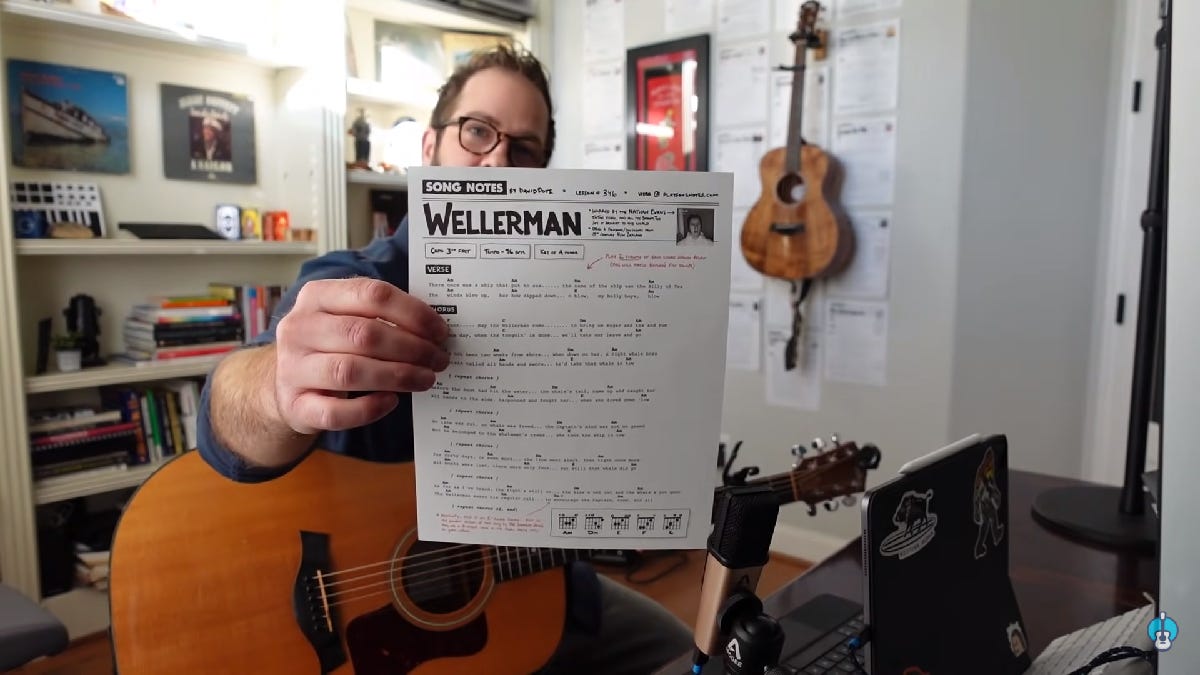
So Potsiadlo did what he always does with his guitar lessons. He first reverse engineered the chord progressions, a relatively easy task given the song’s simplicity. He then recorded a video, opening it with a shot of himself playing a small snippet of the song. Next, the video launches into the lesson itself, showing a close up of his hands on his guitar. As Potsiadlo moves through the verses, the screen flashes graphics that display the actual fret fingering, and he discusses various techniques for how to strum the chords. At the end of the video, he encourages viewers to visit his website to view his annotated notes and lyrics.
Potsiadlo posted the video on January 13, and it quickly climbed to over 26,000 views in just a matter of days. More importantly, it’s one of the top search results on YouTube and Google when you search for “Wellerman guitar tutorial,” which is a good early sign that people will continue landing on it far into the future. Many of Potsiadlo's most popular videos -- those that have millions of views -- amassed their massive audiences over a period of years as people plugged “[song title] + “guitar lesson”] into their search engines of choice. With any luck, his “Wellerman” video will see similar success.
Potsiadlo didn’t start posting regularly to YouTube until four years ago, but the genesis for his online guitar lessons stretches back two decades to when he was in college. He’d grown up taking piano lessons without developing much of a passion for the instrument. He quit by the time he started at the University of Maryland, but he soon grew interested in the guitar. “I was taking a music theory class as an elective just to fill up some requirement,” he told me. “And I started to connect the dots; I had learned all this music theory over the years that I had filed away at the back of my brain, and I realized I could apply most of it to playing the guitar.”
Potsiadlo soon learned he had an almost preternatural ability to listen to a song and transpose it for the guitar. This was during a distinctly Web 1.0 era, so he started posting his guitar notations of popular song lyrics to a Geocities website that he only shared with his friends. He didn’t keep that site going long, but over the next several years he kept up the guitar notation habit and would circulate new pop songs to friends via email.
After graduating, Potsiadlo entered a career in web programming and design, and over a period of years he built up enough of a skillset that he felt confident enough to build an actual CMS that could serve as a database for his sheet music. The CMS allowed for him to enter in various fields -- including the song name and artist -- that made the sheet music more easily searchable, both within the website and on Google. Within a short period of time, his site started attracting between 3,000 and 4,000 visitors a month, mostly from Google. “But it didn't mean anything to me,” he said. “I wasn't receiving emails from people who visited the website. I wasn't doing anything to monetize that audience. I had no entrepreneurial thrust or desire at that time.” His motivation for posting was simply that he enjoyed doing it.
YouTube changed that mindset for him. In 2013, Potsiadlo stumbled upon several channels that provided guitar tutorials for famous songs, and some of them had racked up serious followings. It opened his eyes to the notion that there was a mass market for this type of content.
The guitar, after all, is the closest we have to a universally playable instrument. Most instruments require years of lessons and practice before someone could play something that sounds impressive to the average person, and yet with guitar you can sometimes learn to play a decent rendition of your favorite rock song within a single afternoon. “The guitar can fit in the dorm room, it can fit in the closet,” Potsiadlo explained. “If you can just learn three chords, you could, in theory, pull off something that sounds impressive, as long as you have confidence and some semblance of rhythm.”
Browsing these YouTube channels in 2013, Potsiadlo felt he could produce something better. “The one thing that surprised me like crazy at the time was that the graphics in their videos were almost nonexistent.” When teaching someone to play guitar, the teacher’s hands almost always get in the way of the strings, making it extremely difficult for a beginner to understand the various fingering positions for chords. “I just realized immediately that I could make a visual diagram of each chord that I reuse in every video where that chord is used, and that's going to provide just immediate high value to the viewer who’s trying to learn that song.”
Potsiadlo soon landed on a strategy: he’d record and edit a bunch of videos -- at least a dozen -- in a very short period of time and then post them to YouTube as a sort of “minimal viable product.” From there he could sit back and observe what worked and what didn’t. “I had the sense of mind that if I was going to spend about a month doing this, I should experiment with a wide sample here,” he said. “So I did some of the new indie pop stuff I was listening to at the time, but also I did a few Johnny Cash and Leonard Cohen songs and other classics as well.”
His most inspired idea came while driving back with his daughter from seeing the movie Frozen, which came out that year. “I remember thinking that the songs from the movie were really good. I searched when I got home and there were no tutorials for ‘Let It Go.’” He had already posted a few of his videos, so he quickly pulled together one for “Let It Go” and uploaded it. “It blew up. I think it hit like half a million views in a month.”
While Frozen was the most successful, nearly all 15 of the videos he uploaded in that initial batch saw success, and seven years later they collectively have nearly 3 million views between them. Typically this is the point when the lightbulb goes off in the creator’s head and, realizing they’ve struck content gold, they start repeating and refining their process with more and more videos.
That lightbulb moment didn’t happen for Potsiadlo, at least not then. “I didn't have ads on,” he said. “I had no desire to monetize yet, mostly because I was very much ignorant or naive to the opportunity I'd have from a business point of view.” Though he continued with his guitar playing, he didn’t bother to upload new content to his YouTube channel or website for several years.
But that didn’t stop his channel from continuing to accrue viewers and subscribers. While the channel lay dormant, it slowly grew to 7,000 subscribers -- not exactly a mindblowing number, but certainly big enough that, if Potsiadlo ever decided to relaunch his channel, he would have a small base of subscribers to help get his new videos circulating.
That decision to relaunch came about five years ago. Potsiadlo had moved his family to Austin for a new job, and while they loved the city, the cost of living was higher than expected. “That’s when somebody sent me an unsolicited $10 tip through Paypal,” he recalled. “And it said something like, ‘Hey, I don't know if this is your email address or not, but your guitar stuff is awesome. Thank you so much.’ It like blew my mind because I wasn't encouraging people to tip me at all, but I realized that as dense as I might've been with this stuff, that if this person went out of their way to look up my email address somehow and give me money, then it's silly for me not to make it easier to get paid.”
Potsiadlo finally flipped on monetization for his YouTube channel and added a Paypal link to his website. And though he only started to make a few bucks a week at that point, it was enough to open his eyes that there was real revenue potential there. In May 2016, he started uploading videos on a consistent basis, and he pretty much hasn’t stopped since. That first year he jumped from 7,000 to 17,000 subscribers. The next year it grew to 53,000, and then 100,000 the year after that. And then this past year it exploded to over 260,000.
I wondered how Potsiadlo went about choosing which songs to feature in his videos. The most obvious choice, it seems, would be to go for the classics that appeal to the largest possible audiences -- Johnny Cash, The Beatles, Simon & Garfunkel. Then again, there are likely already hundreds of existing guitar tutorials for these posted across YouTube, sheet music sites, and forums. Perhaps the smarter approach would be to go for the indie favorites by attempting to spot hits as they rose up through the Spotify playlists?
Potsiadlo opts for an eclectic mix. “If I wanted to do just the Top 40 songs, there was a way to do that and the channel would grow a lot faster,” he said. “I flirted with that, but my passion for it just wasn't there. I really want the channel to be almost like my own ongoing diary of ‘here's what I've been playing.’” He tries to include at least one well-known classic every month, but he often steers clear of the karaoke favorites that have been done to death elsewhere. “It's hard to get excited about songs you've heard a thousand times. And honestly, me being excited about a song is going to make for a better lesson, and I can turn it around quicker when it’s a song I’m passionate about.”
As the channel grew, so did the amount he was bringing in via YouTube ads every month. But it became clear fairly quickly that YouTube ads alone would never generate a full-time income, in part because of how copyrighted music is treated on the platform. “Almost as soon as you upload a video, YouTube’s Content ID will detect pretty much immediately whether or not a certain song is owned by a label,” Potsiadlo said. “So basically about a quarter of the song videos I do, I’m sharing monetization on them.” Basically, the vast majority of the revenue goes to YouTube and the rights holder, even though many copyright holders would consider Potsiadlo’s videos as “transformative” work.
Potsiadlo didn’t start making real money from his videos until, in 2018, he launched an account on Patreon. It hadn’t been lost on him that many of his fellow YouTubers had turned to Patreon to generate revenue directly from their fanbases, but he procrastinated on the move for years, only giving in after consistent prodding from friends.
Potsiadlo launched his Patreon with two payment tiers -- $3 and $10 a month -- both offering pretty much the same rewards: PDF versions of the guitar tabs he showed in his videos. “I think the print friendliness is a big thing,” he told me. “Going back all the way to my old website from 2012, I’d get emails like once or twice a month that said, ‘hey, it looks weird when I try to print this out.’ At the time I had no intention of making a custom style sheet, and I just kind of said, ‘sorry, but you can edit it yourself.’” But given that most sheet music is still used in print form -- usually placed on some kind of music stand -- Potsiadlo understood that there was a real utility to a print-friendly version that people might pay for.
So Potsiadlo shot a video announcing his Patreon account and pinned it to the homepage of his channel. He also began incorporating a plug for the Patreon in all his new videos, noting that it was a way for viewers to access a high-quality version of his music. “Within a few months, my Patreon revenue surpassed my YouTube AdSense money,” he said. “And I realized that this was not only much more satisfying, but that there was a mountain of potential here in terms of how I could scale monetization.”
For the first two years, new Patreon subscribers trickled in on a regular basis. It took Potsiadlo several months before he hit 300. By 2020, he had about 2,000. Then Covid hit, and his subscriber base exploded. “It's been insane over the last six months. I reached 3,000 patrons four months ago, and I just hit 5,000 today.” My back-of-the-envelope calculations place him somewhere north of making $10,000 a month just from Patreon alone.
And all that’s from 10 hours of work a week, which includes choosing a song to feature, practicing it, recording a video tutorial, and marketing the video. Potsiadlo still works a day job, and though he was hesitant to name an end date, he acknowledged that one day in the future he’d like to work on the YouTube channel full-time.
In our phone conversation, he seemed almost embarrassed to suggest that such a day would come, and I asked him why. “Up until two or three years ago, there was a part of me that couldn’t get over the huge mental hump and even dare to dream about doing this full-time one day,” he said. “There was a voice in my head that would say, ‘how dare you even think that?’” Recently, however, he’s begun to acknowledge that there’s a thriving career in music waiting for him when he’s ready. After all, how could 5,000 strangers clamoring to give him money on Patreon be wrong?
Do you like this newsletter?
Then you should subscribe here:
Simon Owens is a tech and media journalist living in Washington, DC. Follow him on Twitter, Facebook, or LinkedIn. Email him at simonowens@gmail.com. For a full bio, go here.