
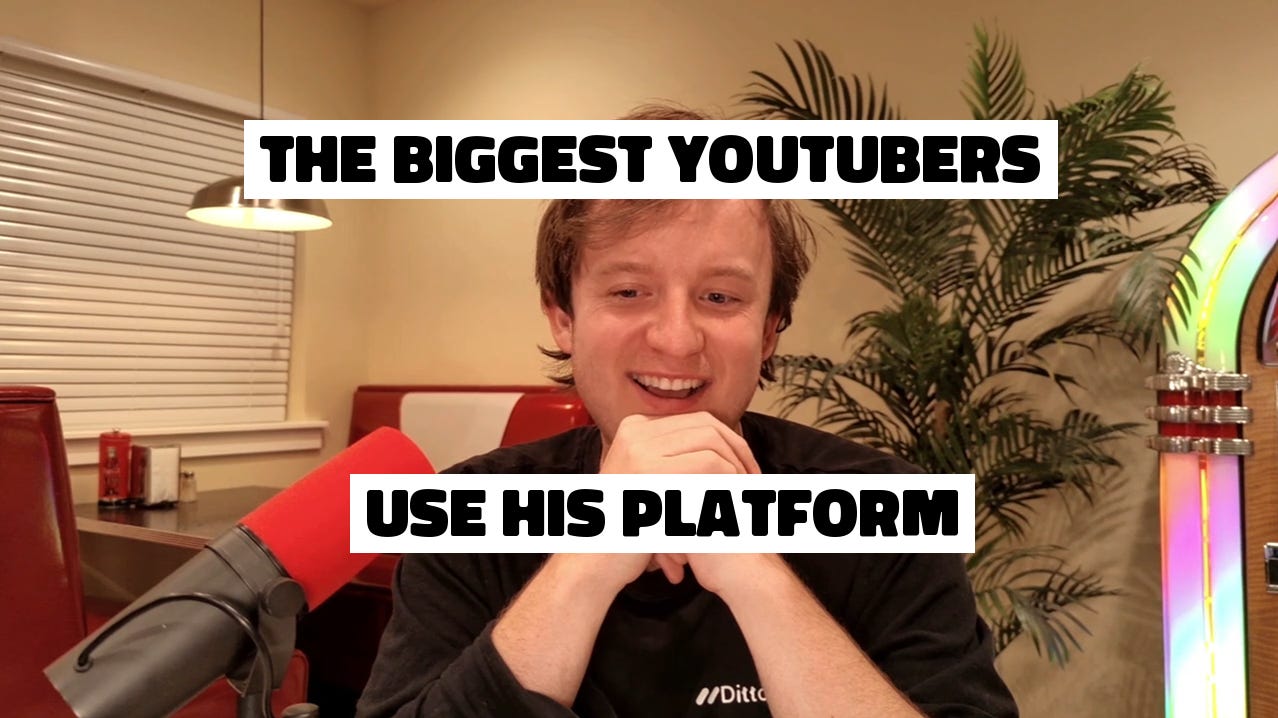
Nate Stone was still in high school when he learned one of the creator economy’s most important lessons: a huge audience does not necessarily make for a satisfying business. At 15, he launched a science and engineering YouTube channel called Keystone Science, eventually attracting hundreds of thousands of subscribers with videos about high-voltage electricity and homemade electronics. But as the audience grew, Stone became increasingly frustrated by the demands of feeding the YouTube algorithm. Producing a video every week left little room for the kind of ambitious projects he actually wanted to build. He eventually stopped uploading, studied physics, math, and computer science, and went to work on AI for Amazon’s Alexa team.
That experience eventually led him back to YouTube, only this time as a software founder. In 2022, Stone and his brother began building DittoDub, an AI-powered dubbing platform that helps creators translate their videos into dozens of languages while preserving the original speaker’s voice, emotion, and delivery. What began as a solution to a problem Stone encountered as a teenage creator has since grown into a profitable company used by thousands of YouTube channels, including some of the platform’s largest creators. Along the way, DittoDub has benefited from three major shifts: rapidly improving AI models, YouTube’s embrace of multi-language audio, and the realization among creators that international audiences can dramatically increase the ceiling on their growth.
In a recent interview, Stone explained how his frustrations as a teenage YouTuber helped inspire DittoDub, why the company focused on winning over large creators through product quality and word of mouth, and how multilingual audio can trigger enormous audience growth on YouTube.
Let’s jump into it…
Walking away from the creator treadmill
Stone did not start Keystone Science with a media strategy. He was building electronics projects in his garage, often breaking them in the process, and began filming himself so he could understand what had gone wrong. He uploaded those recordings to YouTube, people began finding them, and the videos gradually evolved into more polished tutorials.
The first six months brought around 10,000 subscribers. Then Stone published a video showing how to build a small electromagnetic pulse device. Over the next few weeks, he gained roughly 100,000 subscribers. Another video involving a handheld microwave device added roughly another 100,000. Stone had stumbled into the kind of viral growth that many aspiring YouTubers spend years chasing.
But he never became particularly interested in the status that came with it. Even receiving YouTube’s creator award for passing 100,000 subscribers failed to mean much to him. “When I got it, it was like, okay, I don’t really care about this at all,” he said. “Since then, it’s just been sitting in a box somewhere.”
More importantly, Stone began to dislike the production cycle required to keep growing. At the time, he felt YouTube rewarded creators who published every week. That rhythm made sense for the platform, but it did not match the kind of work he wanted to do.
“I really can’t make anything good that will actually have an impact on the world within one week,” he recalled thinking. “And so that kind of concept and that cycle started to disenchant me from the whole space.”
Stone chose not to optimize around that system. He gradually stopped publishing and shifted his attention toward machine learning. Around 2020, he worked as an AI engineer on Amazon’s Alexa team while experimenting with AI projects on the side with his brother.
The irony is that his frustration with YouTube eventually became the foundation for a company serving YouTubers.
Paywall incoming…
The rest of this case study is behind a paywall, but if you aren’t ready to subscribe, you can also download it as an ebook over here.